Page Content
Reprinted from the ATA Magazine (May 1961, volume 41 number 9, page 24)
 Seven specialist councils were officially launched at inaugural conferences held in Edmonton recently. The Council on School Administration held its inaugural meeting on March 25, and the conferences of the English, Home Economics, Industrial Arts, Business Education, Social Studies, and Science Councils were held on April 6 and 7.
The Guidance Council, formerly the Alberta Guidance Association, held its first conference under its new name in Red Deer on April 6 and 7.
Guidance Council
Early in 1961 the Alberta Guidance Association became the Guidance Council of The Alberta Teachers’ Association. On April 6, the guidance counselors and special class teachers registered at the Lindsay Thurber Composite High School in Red Deer for a two-day meeting. It was the first occasion at which an outstanding out-of-province educationist has been the guest speaker. It was the first time attendance has moved above 100—this year over 140 registered. It was the first time so many superintendents, departmental officials, and the University of Alberta professors have attended.
Dr. Franklin Seran, dean of Oregon State Teachers’ College, set the theme of the conference in a keynote address, “Guidance and the Administration”. A panel including Dr. Zeran; Dr. P.F. Bargen, superintendent of West Jasper Place Public schools, J.W. James, assistant superintendent, Calgary Public schools, and W.H. Cooper, principal of Crescent Heights High School, Calgary, dealt with the question: “Can costs of providing counseling services be justified?” The panel agreed that there is a genuine need for counseling in all junior and senior high schools, that some staff member or members have to do this counseling, and that it is more economical and more effective to provide time and trained personnel to do the job than to let untrained staff members counsel and encroach on their teaching time.
The special education teachers’ section was attended by approximately 30 teachers and administrators. Dr. J.A. Stewart of the Faculty of Education, Calgary, dealt with problems of making differential diagnoses in assessing mentally handicapped children for special placement. Dr. C. Safran, supervisor of guidance and special education in Calgary, discussed general problems in the administration and operation of opportunity classes. Problems and solutions related to the education of sight-handicapped children were presented by Miss E. Leak of Calgary. Dr. R.E. Rees, assistant chief superintendent of schools, outlined the history of the development of special education in Alberta.
At the closing business session, R.E. Shaul, supervisor of junior high school education, Edmonton Public Schools, was elected president for the 1961-62 year, and Loring Pollock, guidance counsellor at the Lindsay Thurber High School, was chosen as president-elect. Mrs. A. Krahulec, Strathearn Junior High School, Edmonton, is secretary-treasurer.
English Council
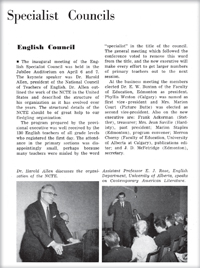
The inaugural meeting of the English Specialist Council was held in the Jubilee Auditorium on April 6 and 7. The keynote speaker was Dr. Harold Allen, president of the National Council of Teachers of English. Dr. Allen outlined the work of the NCTE in the United States and described the structure of his organization as it evolved over the years. The structural details of the NCTE should be of great help to our fledgling organization.
The program prepared by the provisional executive was well received by the 130 English teachers of all grade levels who registered the first day. The attendance in the primary sections was disappointingly small, perhaps because many teachers were misled by the word “specialist” in the title of the council. The general meeting which followed the conference voted to remove this word from the title, and the new executive will make every effort to get larger numbers of primary teachers out to the next session.
At the business meeting the members elected Dr. E.W. Buxton (Faculty of Education), Edmonton, as president. Phyllis Weston (Calgary) was named as the first vice-president and Mrs. Marion Court (Picture Butte) was elected as second vice-president. Also on the new executive are Frank Ackerman (Stettler), treasurer; Mrs. Jean Saville (Hardisty), past president; Marion Staples (Edmonton), program convener; Merron Chorny (Faculty of Education, University of Alberta at Calgary), publications editor; and J.D. McFetridge (Edmonton), secretary.
Home Economics Council
The Home Economics Council held its inaugural conference in the Victoria Composite High School on April 6 immediately following the annual conference of the Alberta Home Economists. Approximately 50 home economics teachers were in attendance.
In addition to the business portion of the meeting, members present heard addresses by Dr. S.C.T. Clarke on the concept of specialist councils, and by Dr. E. Empey, director of the School of Home Economics, regarding future plans on home economics at the university.
Dr. Clarke stated that the basic objective of specialist councils is to improve practice in the specialty by increasing members’ knowledge and understanding. Specialist councils, he predicted, would conduct annual conferences, summer seminars, publish bulletins or newsletters, and assist regional councils in programming inservice activities. Dr. Empey outlined plans for facilities and curriculum presently being considered by the University of Alberta.
Muriel Shortreed of Lethbridge was elected president of the council and Freda Quinton of Calgary was elected secretary.
Business Education Council
“Machines That Teach—New Advances in Education” was the basis of a speech given by Dr. Leonard West at the Business Education Council held on April 6 and 7. Dr. West, who is associate professor of business education at Southern Illinois University, appealed to his audience to give prominence to the fundamental principles of learning: motivation, learner activity, prominence of the important idea, sequential presentation at a rate that is right for each individual, and the learner’s knowledge of his own success. He continued by explaining the appearance, advantages, and disadvantages of nine teaching machines, including the polymath, the Auto-Tutor, and the Saki. He also pointed out how these machines can be used to give personalized, individual attention, and explained how subject matter can be geared to the level of the learning and maturity of each student.
 Using as his text, Saber-Tooth Curriculum (Harold Benjamin, McGraw-Hill, New York, 1939) William L. Darnell, editor-in-chief of the Gregg Publishing Company, warned teachers that they must keep step with the changing times. Geraldine Farmer outlined the future plans in business education at the University of Alberta.
Toby Dublanko and Malcolm McDonald exchanged views with P.A. Clark, assistant personnel and safety manager of Northwestern Utilities, and Lloyd Atwell, office manager of Canada Packers, on how well education was meeting the needs of businessmen. Both Mr. Atwell and Mr. Clark deplored the shortage of men of executive calibre. Mr. Clark asked that our students be able to spell and write, and that we try to teach them to be secure and less materially-minded individuals.
Members on a panel on the evaluation of the business education curriculum—Ethel Fildes, Mary Silcox, Charles DeTro, and George Tomlin—felt that what we do teach we must teach well and that more attention must be given to basic fundamentals.
The 1961 Executive included Ronald Ross, Calgary, president; Michael Ukrainetz, Westlock, vice-president; John Tarangle, Calgary, secretary-treasurer; Geraldine Farmer, assistant professor, Faculty of Education, University of Alberta, and R. C. Ohlsen, superintendent of schools, Ponoka, directors; and John Yusep, Edmonton, past president.
Science Council
The countdown of the first meeting of the Science Council held on April 6 and 7 at the Ross Sheppard High School, Edmonton, was under the guidance of John A. McDonald, president of the Alberta Teachers’ Association. He presented a provisional constitution which, after some modifications suggested by the 70 science teachers in attendance, was ratified.
During the first afternoon, Dr. Paul deHart Hurd, professor of science education, Stanford University, discussed some recent trends and developments in science education. This leading American educator elaborated upon the idea that most of the new courses are centred around a major generalization. One new high school chemistry course is built around the bond theory. A modern biology course uses an ecological approach as its core. There is a strong trend, he said, toward the teaching of science at a conceptual level and away from the teaching of science technology. In the latter type of teaching, science never leaves the realm of application. Of course this recent development has strong professional overtones. New courses, Dr. Hurd said, must be taught by new methods. Biology, a study of living things, can no longer be taught through a panorama of dried leaves, pickled frogs, and stuffed mammals. All this implies new learning aids and a more realistic approach to the laboratory where future emphasis will be on methods of science as opposed to verification of facts. The old methods just won’t work on such courses.
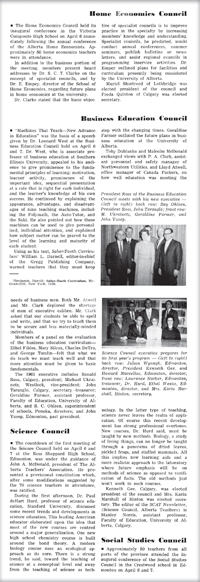
Kenneth Gee, Calgary, was elected president of the council and Mrs. Karin Marshall of Hinton was elected secretary. The editor of the SCAT Newsletter (Science Council Alberta Teachers) is Stanley Morris, assistant professor, Faculty of Education, University of Alberta, Calgary.
Social Studies Council
Approximately 80 teachers from all parts of the province attended the inaugural conference of the Social Studies Council in the Crestwood School in Edmonton on April 6 and 7. During the business portion of the meeting a constitution was adopted, a membership fee of $5 was set, and plans were made for future activities on both a provincial and regional basis. M. R. Lupul, assistant professor of education, University of Alberta, in an address to the group, spoke on “Controversial Issues in Social Education.” A demonstration lesson by Agnes Buckles with a junior high school class showed the effectiveness of group dynamics in teaching. A discussion and evaluation of these techniques was carried on after the lesson.
Evelyn R. Moore, assistant professor of education, University of Alberta, who has taught and studied in both Australia and England gave a most interesting talk on “Comparative Social Education.” Methods and techniques, and philosophies and subject matter from these two countries were compared with those of Alberta.
A slate of officers for 1961 was elected. Edgar T. Wiggins of Didsbury is the president and Dorothy McNary of Bowness is the secretary.
Industrial Arts Council
Seventy-five arts teachers from the four corners of the province attended the inaugural conference of the Industrial Arts Council in the Bonnie Doon Composite High School in Edmonton on April 6 and 7.
Guest speaker Professor J.C. Spry of the Ontario College of Education, spoke on two topics—“Professionalism in Industrial Arts” and “Safety Education in School Shops”. Other speakers were R. Cunningham, supervisor of industrial arts, who discussed the curriculum guides; R.E. Byron, director of vocational program for secondary schools; and Dr. T.G. Finn of the University of Alberta in Calgary, who outlined the changes proposed in the industrial arts teacher-training program.
On Thursday evening, a commercial display and demonstration was presented by the Fairbanks Morse Company. A large number of projects and teaching aids from all parts of the province were on display for the benefit of those attending the conference.
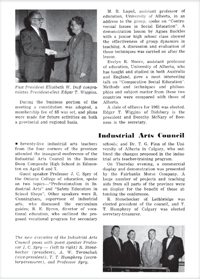
R. Stonehocker of Lethbridge was elected president of the council. And T.T. Humphrey of Calgary was elected secretary-treasurer.
Council on School Administration
The inaugural conference of the Council on School Administration held in the Bonnie Doon Composite High School, Edmonton, on March 25, took the form of a business meeting and a discussion of future activities. E.J. Ingram, who addressed the conference on the concept of specialist councils stated—
The initiation and organization of specialist councils is probably the most significant activity undertaken by The Alberta Teachers’ Association in many years and will no doubt be the major professional activity of the Association in the years to come. It is hoped that members of specialist councils will serve as examples and be master teachers in their specialty. It is hoped that such members will be the corps of individuals who will assist in curriculum construction and who will provide authoritative opinion on matters related to their specialty.
 Dr. J.H.M. Andrews addressed the conference on possible future activities. He suggested that the council consider the publication of a periodic bulletin or newsletter to keep the members up to date on the latest practices and research in educational administration. A voluntary summer workshop which could serve as a source of inspiration and information was another possibility mentioned by Dr. Andrews. He also suggested that a research committee, which could serve as a clearing house for local research projects and which could undertake needed research at the provincial level, was worthy of consideration. At the regional level, Dr. Andrews suggested that the council could consider the holding of administrators’ institutes, the conducting of action research projects, and the sponsorship of sectional programs at fall conventions.
H.A. Wallin, principal of the University Demonstration School in Edmonton, was elected president of the council, and F.J. Senger, principal of the Calmar Elementary School, was elected as secretary-treasurer.